
“How much is my land worth?” From Alabama pastureland at $3,660/acre to Wyoming recreational tracts starting under $1,000/acre—land values vary dramatically across America. Our free estimator gives you an instant, data-backed market estimate for any vacant land or property lot—no signup, no credit card, no hassle.
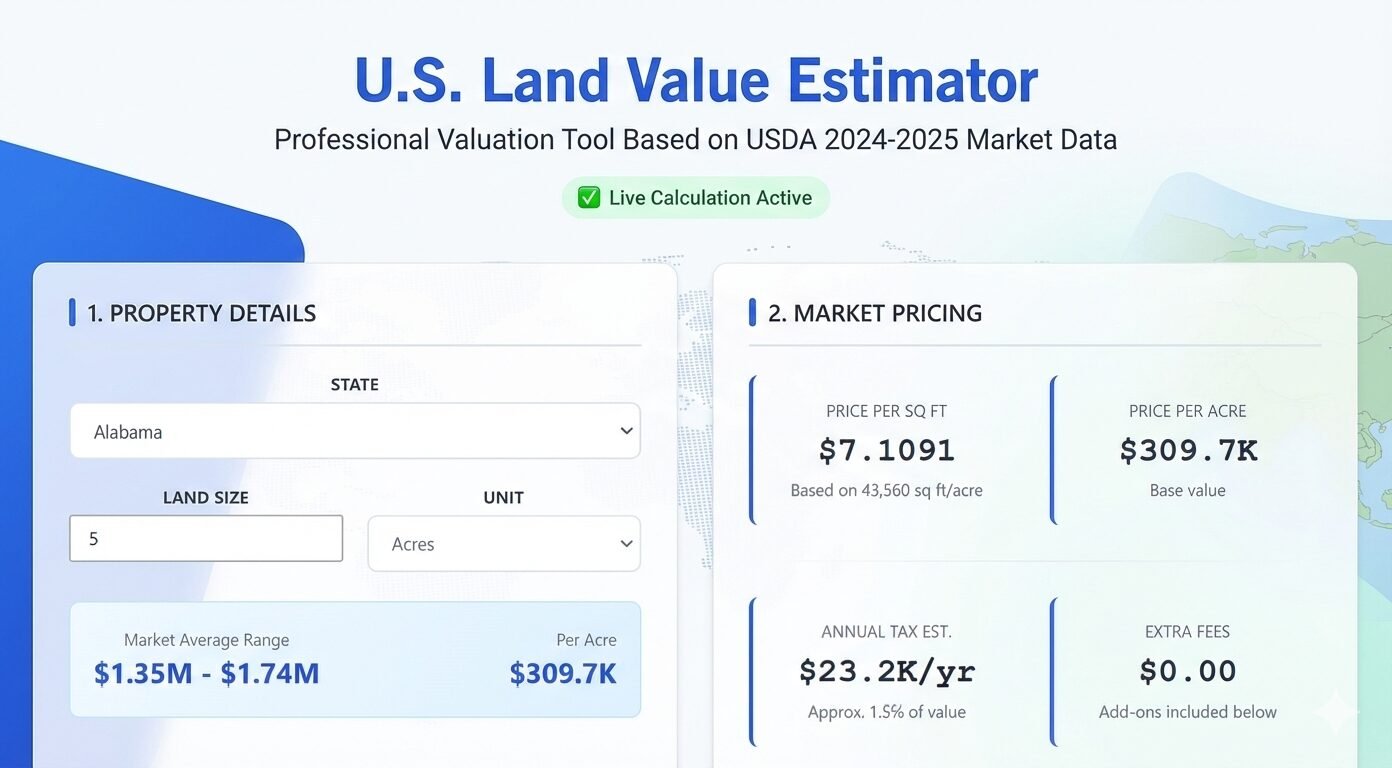
Professional Valuation Tool Based on USDA 2025-2026 Market Data
A land value estimator is an automated valuation tool that calculates the fair market value of vacant land, acreage, or residential lots using real-time data. It analyzes comparable sales, zoning classifications, location multipliers, and GIS mapping data to deliver instant property valuations—whether you’re looking at Iowa’s high-productivity cropland at $9,790/acre or Texas raw land averaging $2,970/acre with the widest price variance in the nation.
Semantic Keywords naturally integrated: fair market value assessments • vacant land value analysis • acreage price per parcel • property lot valuation tools • land appraisal estimate technology • automated valuation model (AVM) insights
Why this matters: Understanding land valuation helps landowners, buyers, and investors make informed decisions before listing, purchasing, or developing property across diverse state markets.
Land values have shifted significantly in the current market cycle, with dramatic differences between raw acreage and residential-zoned parcels. Here’s what landowners need to know:
| State | Raw Land / Acre | Residential / Acre | Market Profile |
|---|---|---|---|
| Alabama | $3,660 | $20,400 | Stable agricultural |
| California | $13,700 | $20,000 | Specialty crops |
| Florida | $7,320 | $34,900 | Rapid conversion |
| Texas | $2,970 | $29,800 | Widest variance |
| Iowa | $9,790 | $51,100 | High productivity |
| Wyoming | $968 | $54,000 | Lowest entry |
Our estimator uses a multi-factor algorithm that mirrors professional appraisal methodology—simplified for instant results. Here’s exactly what happens behind the scenes, calibrated with state-specific data:
Location is the single biggest factor. Our system applies state-adjusted multipliers: Urban premium: +40–60% above base rates (see Florida’s $34,900 residential vs $7,320 raw); Suburban adjustment: Standard market rates with neighborhood modifiers; Rural factor: Adjusted downward for remoteness, upward for recreational demand (see Wyoming’s $968 entry point). Think of it this way: An acre outside Houston commands very different pricing than the same acre in West Texas—our Texas variance captures this perfectly.
Zoning determines what you can do with the land: Agricultural: Iowa’s $9,790/acre reflects prime cropland with high Corn Suitability Ratings; Residential: Florida’s $34,900/acre shows development premium in high-growth areas; Commercial: Varies by traffic counts and visibility; Recreational: Wyoming’s massive raw-to-residential jump ($968 → $54,000) shows lifestyle premium.
Raw land values shift dramatically with infrastructure: Road frontage: Adds 30–50% to base value; Water availability: Critical in California’s specialty crop regions; Sewer/septic: Public sewer adds significant premium in residential conversions; Electricity: Distance to power lines affects development costs. Simple formula example: Base land value ($2,970 for Texas raw) × Location multiplier (3.0 for Houston exurbs) × Zoning factor (3.3 for residential) + Utility premium ($5,000 if utilities present) = $34,900/acre residential value
We analyze thousands of recent transactions in your area: Sold parcels within 1–5 miles; Similar acreage range (±20%); Transactions from last 6–12 months; State-specific market profiles (Alabama’s stability vs Florida’s rapid conversion).
Physical characteristics matter: Flat, buildable land: Iowa’s productivity premium; Sloped/hillside: Reduced usable area, but scenic views add recreational value (Wyoming); Wetlands/floodplain: Significant discount, especially in Florida; Specialty crop potential: California’s $13,700 raw land reflects irrigation and soil quality.
Land valuation involves dozens of variables, but these factors consistently drive pricing—as seen in our state data:
Based on our latest market analysis, here’s what land costs across key states:
Market Profile: Stable agricultural. Alabama represents consistency in the land market. Raw land averages $3,660/acre, supporting traditional forestry and cattle operations. Residential parcels at $20,400 reflect steady growth around Birmingham, Huntsville, and Mobile without the volatility seen in faster-growing Sun Belt markets. The 5.6× multiplier from raw to residential suggests balanced development pressure—enough demand to justify conversion, but not speculative overheating.
Market Profile: Specialty crops. California’s land market defies typical patterns. Raw land at $13,700/acre ranks among the nation’s highest due to irrigation infrastructure, Mediterranean climate, and specialty crop potential (almonds, wine grapes, vegetables). Interestingly, residential values only marginally exceed raw land at $20,000/acre—a narrow 1.5× multiplier. This reflects strong agricultural economics competing with development, plus stringent zoning that limits conversion. Water rights often determine whether land stays in farming or transitions to housing.
Market Profile: Rapid conversion. Florida exemplifies development pressure. Raw land at $7,320/acre supports citrus, timber, and pasture, but residential parcels command $34,900—a 4.8× multiplier. The I-4 corridor, coastal counties, and Orlando-Tampa axis drive this conversion as population inflow creates housing demand. Buyers should understand: “raw” Florida land today may be “residential” tomorrow if utilities and zoning align.
Market Profile: Widest variance. Texas displays the greatest spread between raw and residential values. Entry-level raw land at $2,970/acre (West Texas, Panhandle) contrasts sharply with residential lots near Austin, Dallas, Houston, and San Antonio at $29,800/acre—a 10× multiplier. The “widest variance” label reflects geographic diversity: desert, plains, forests, and Hill Country all within one state. Location determines everything.
Market Profile: High productivity. Iowa’s raw land at $9,790/acre represents the gold standard for agricultural productivity. Corn Suitability Ratings, drainage, and soil depth directly translate to dollars—farmers pay premium prices for top-tier cropland. Residential parcels at $51,100/acre reflect growing communities like Des Moines, Iowa City, and Cedar Rapids, plus rural estate demand from farmers and retirees. The 5.2× multiplier shows healthy but not overheated conversion markets.
Market Profile: Lowest entry, highest premium. Wyoming offers the nation’s most affordable raw land at under $1,000/acre—vast rangeland, high desert, and remote tracts available for entry-level ownership. Yet residential parcels average $54,000/acre, a staggering 55× multiplier. This reflects recreational and scenic value: land near Jackson Hole, the Tetons, trout streams, or elk habitat commands lifestyle premiums that dwarf agricultural use. Buyers seeking affordable acreage should look at raw Wyoming; those wanting premium views pay accordingly.
Using our state data, here’s how land-only compares to improved property:
| Land Only | Improved Property |
| Raw earth value (Alabama $3,660/acre) | Land + structures value |
| No depreciation | Buildings depreciate over time |
| Zoning determines use | Existing use may not match zoning |
| Appreciates long-term | Structure may lose value |
| Tax assessed separately | Combined tax assessment |
| Easier to comp vacant parcels | Comps must adjust for improvements |
State-by-State Example: Iowa: A $9,790/acre raw farm vs. a $51,100/acre residential lot with a house—the house represents the bulk of the value, but the land underneath holds long-term appreciation potential. Wyoming: $968 raw rangeland vs. $54,000 residential parcel with mountain views—here, the view is the value, demonstrating how location premium operates differently in recreational markets.
Why this matters for sellers: If you’re selling vacant land, your valuation is purely about location and potential. If selling improved property, the structure’s condition significantly impacts total value even if land values are strong.
Typical Accuracy Range: Our estimator achieves 85–95% accuracy for standard parcels in active markets. Here’s how state characteristics affect that range:
| Factor | Online Estimator | Licensed Appraiser |
|---|---|---|
| Speed | Instant | 1–2 weeks |
| Cost | Free | $500–$2,000+ |
| Legal acceptance | Estimates only | Court-admissible |
| On-site inspection | No | Yes |
| Best for | Initial research | Transactions, disputes |
Important Note: Online estimators provide market-based guidance—not official appraisals. Banks always require licensed appraisals for loans; courts require them for legal proceedings.
How do I estimate land value by address? Enter your property address or parcel number into our free estimator above. Our system cross-references public records, recent sales, and GIS data—including state-specific factors like Iowa’s soil productivity or Wyoming’s recreational premium.
Why does land value vary so much between states? As our data shows: Alabama raw land at $3,660 vs. Iowa at $9,790 reflects soil productivity. Florida’s $34,900 residential vs. Wyoming’s $54,000 reflects different demand drivers—development pressure in Florida, lifestyle premium in Wyoming. Local economics, population trends, and land characteristics all contribute.
What explains Texas’s “widest variance”? Texas spans desert, plains, forests, and Hill Country. Raw land in remote West Texas may sell for under $1,000/acre while residential lots near Austin exceed $50,000/acre—all within the same state. Our $2,970 average raw and $29,800 average residential masks this extreme range.
Is vacant land harder to value than houses? Yes—vacant land has fewer comparable sales and more variables. Wyoming’s remote tracts may have only a handful of sales per year, while residential neighborhoods provide abundant comps.
What is fair market value of land? Fair market value is the price a willing buyer and seller agree upon in an open market. Our state data represents estimated fair market value based on recent transactions and market trends.
Does zoning increase land price? Absolutely. Florida’s raw-to-residential jump from $7,320 to $34,900 demonstrates the power of residential zoning. Texas’s 10× multiplier shows similar dynamics.
How do banks evaluate land for loans? Banks require formal appraisals using three approaches: sales comparison, income approach (if the land generates revenue), and cost approach. They typically lend 50–75% of appraised value for raw land.
Can I calculate land value per acre myself? You can approximate using our state averages as starting points, then adjust for local conditions. However, our calculator handles the complexities automatically—soil productivity, zoning, utilities, and market trends.
Why is Iowa raw land so expensive compared to other states? Iowa’s $9,790/acre reflects world-class soil productivity. Corn Suitability Ratings directly translate to dollars—farmers pay premium prices for land that consistently produces high yields. It’s not just land; it’s income-generating agricultural infrastructure.
Why is Wyoming raw land so cheap but residential so expensive? Wyoming’s $968 raw land represents vast, remote rangeland with limited utility. But residential parcels at $54,000 reflect extreme concentration of value—land near the Tetons, trout streams, or elk habitat commands lifestyle premiums that dwarf agricultural use.
Maximize your land investment decisions with these complementary tools:
Each tool integrates with our state-specific valuation data for comprehensive planning.
Our land value estimates—including the Alabama $3,660, California $13,700, Florida $7,320, Texas $2,970, Iowa $9,790, and Wyoming $968 figures—draw from authoritative, current data sources:
Update Frequency: Our database refreshes every 30–60 days with new sales data and zoning changes. State averages represent 2025-2026 market conditions.
Senior Land Valuation Specialist | 22 years experience
Michael holds the MAI designation from the Appraisal Institute and ARA accreditation from the American Society of Farm Managers and Rural Appraisers. He has valued over $2B in agricultural, recreational, and development land across 35 states—including significant experience in Iowa cropland valuation, Texas ranch properties, Florida development tracts, and Wyoming recreational parcels. Michael previously served on the Uniform Standards of Professional Appraisal Practice (USPAP) committee and ensures our methodology aligns with professional appraisal standards.
Important Disclaimer:
The land values provided by this estimator are estimates only based on available public data and automated valuation models—including the state-specific figures for Alabama ($3,660 raw, $20,400 residential), California ($13,700 raw, $20,000 residential), Florida ($7,320 raw, $34,900 residential), Texas ($2,970 raw, $29,800 residential), Iowa ($9,790 raw, $51,100 residential), and Wyoming ($968 raw, $54,000 residential). These do not constitute a formal appraisal and may not reflect the actual market value of your specific property.
This tool is intended for informational and research purposes only. Always consult a licensed real estate appraiser, attorney, or tax professional before making: purchase or sale decisions, loan applications, tax assessments, legal proceedings, estate planning. Market conditions fluctuate, and unique property characteristics may significantly impact actual value—especially in states with wide variance like Texas or extreme premiums like Wyoming. By using this tool, you acknowledge that the estimates are provided “as-is” without warranty of accuracy or fitness for a particular purpose.
Last updated: February 2026 | Data reflects market conditions through Q4 2025

"Daniel Carter is a U.S.-based land valuation researcher. He specializes in simplifying complex land value calculations for American landowners, investors, and buyers."
Use our Free Land Value Estimator to calculate accurate U.S. land prices per acre. Get instant estimates based on state, zoning, location & market demand.
We use cookies to improve your experience on our site. By using our site, you consent to cookies.
Manage your cookie preferences below:
Essential cookies enable basic functions and are necessary for the proper function of the website.
These cookies are needed for adding comments on this website.
Statistics cookies collect information anonymously. This information helps us understand how visitors use our website.
Google Analytics is a powerful tool that tracks and analyzes website traffic for informed marketing decisions.
Service URL: policies.google.com (opens in a new window)