Texas Land Loan Calculator – Estimate Payments for Raw, Unimproved, and Improved Land
Buying land in Texas is different from buying a home. Prices vary widely across regions, and land loans require higher down payments and stricter terms.
Our Texas Land Loan Calculator gives you accurate, Texas-specific estimates based on real land types, regional prices, and lender rules like VLB and Farm Credit.
Texas Land Loan Calculator Free
| # | Pmt | Prin | Int | Bal |
|---|---|---|---|---|
| Enter details to view schedule | ||||
Share Your Experience
How This Texas Land Loan Calculator Works
We have removed the guesswork by integrating real-time market data and lender guidelines directly into the tool. Here is how the logic works behind the scenes to give you an accurate estimate. [Advance Land Value Estimator]
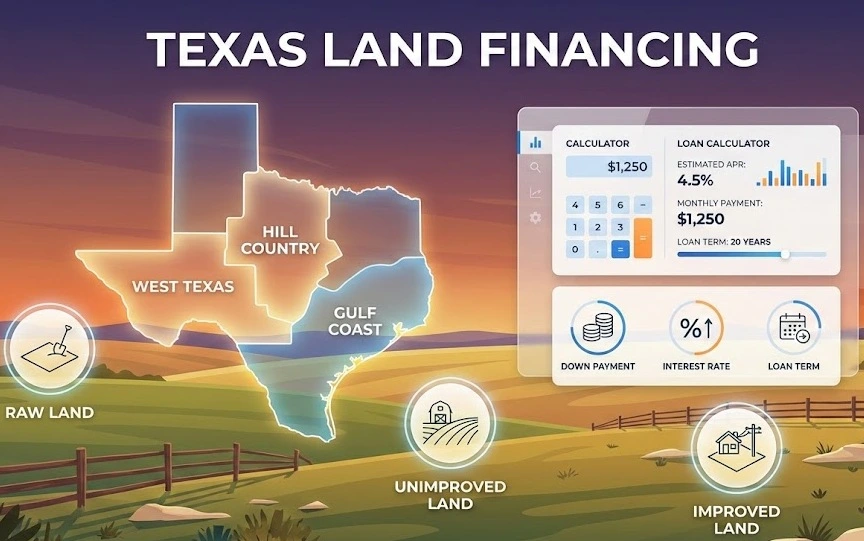
1. Select Your Texas Land Type
Lenders categorize risk based on the state of the land. Your choice here determines your required down payment.
- Raw Land: Completely undeveloped with no utilities or road access. This carries the highest risk.
Requirement: Expect a 35–50% down payment. - Unimproved Land: Has some basic utilities (like electricity nearby) but lacks a foundation or meter.
Requirement: Mid-level risk; usually requires 20–30% down. - Improved Land / Lot: Construction-ready with full utility access (water, sewer/septic, electric) and road frontage.
Requirement: Lowest risk; requires 10–20% down.
2. Choose Region (Price Per Acre Auto-Fill)
Texas is massive, and land prices vary wildly. When you select a region, the calculator uses 2024–2025 market averages to help you estimate costs if you haven’t picked a specific lot yet:
~$9,615/acre
(Highest rates due to industrial/port demand)
~$8,200/acre
~$7,306/acre
~$5,945/acre
~$2,727/acre
$1,831–$1,911/acre
~$612/acre
(Lowest cost, typically arid grazing land)
3. Select a Loan Provider
Different lenders play by different rules in Texas.
- Farm Credit System (Capital Farm Credit, Texas Farm Credit): Specialized in rural land. They often require 20% down but offer a Patronage Rebate, which returns a portion of the interest to you, effectively lowering your rate.
- Texas Veterans Land Board (VLB): The best option for eligible veterans. Offers 5% down, terms up to 30 years, with a loan limit of $150,000.
- Credit Unions: A solid alternative, typically requiring 20% down with APRs currently hovering between 6.5–8%.
4. Interest Rate, Loan Term & Down Payment
Once you select your parameters, the calculator auto-enforces the limits. For example, it won’t allow a 5% down payment on Raw Land unless you are using a VLB loan, ensuring your results are realistic.
Understanding Land Loan Requirements in Texas
Before you apply, you need to know what underwriters are looking for. Because land cannot be instantly sold or rented out like a house, banks require stronger borrower profiles.
Down Payment & LTV Standards
The Loan-to-Value (LTV) ratio tells you how much the bank is willing to lend versus how much cash you must bring to the table.
| Land Type | Down Payment | Loan-to-Value (LTV) |
|---|---|---|
| Raw Land | 35% – 50% | 50% – 65% |
| Unimproved | 20% – 30% | 70% – 80% |
| Improved / Lot | 10% – 20% | 80% – 90% |
Credit Score, DTI, & Reserves
To get approved for a land loan in Texas, you generally need to meet these benchmarks:
- Credit Score: Most lenders look for 680–720+.
- Debt-to-Income (DTI) Ratio: Maximum 43%.
- Cash Reserves: Banks often want to see 6–12 months of payments in the bank to ensure you can weather financial dips.
Texas Land Market Prices (2024–2025)
Here is a quick overview of what you can expect to pay per acre across the state’s distinct regions. Source
Region-Wise Breakdown
- Panhandle: Affordable and flat, largely agricultural. Be aware of water scarcity risks here.
- Far West Texas: The cheapest land in the state (~$612/acre), but the market can be volatile and infrastructure is sparse.
- West Texas: Prices are driven higher by oil and energy industry demand.
- Northeast Texas: High demand for timber and recreation; lush and green.
- Gulf Coast: The most expensive region due to proximity to Houston, ports, and industrial expansion.
- South Texas: Famous for “Brush Country”—prime territory for hunting and wildlife ranches.
- Hill Country: The premium market. Scenic views and proximity to Austin/San Antonio keep prices high ($7,306/acre).
Types of Texas Land Loans (Full Guide)
Farm Credit System Loans
These are cooperatives owned by their borrowers.
- Standard LTV: 80% (20% down).
- Patronage Rebate: This is a game-changer. It effectively lowers your APR by refunding you a percentage of the interest paid at the end of the year.
- Best For: Rural tracts, recreational land, and farms.
Texas Veterans Land Board (VLB)
If you are a Texas veteran, this is likely your best route.
- Down Payment: Only 5%.
- Term: Up to 30 years (rare for land loans).
- Limit: Max loan amount of $150,000.
Credit Union Land Loans
Community banks and credit unions are great for smaller, local lots.
- Terms: Typically shorter, often 5–15 years.
- Down Payment: Usually 20%.
What Affects Texas Land Loan Payments?
Regional Price Differences
Your monthly payment is heavily dictated by location. Buying 10 acres in Far West Texas might cost $6,120, while the same size plot on the Gulf Coast could cost $96,150.
Utilities & Land Status
“Cheap” land often has hidden costs. Raw land requires the highest capital for development:
- Well Drilling: $9,000 – $20,000+ depending on the water table.
- Fencing: $1,000 – $38,000 per acre depending on materials (barbed wire vs. pipe fencing).
Property Taxes & Ag Exemptions
Pro Tip: In Texas, an Agricultural (Ag) Exemption is gold. It drastically reduces your property taxes, sometimes by 90%+. However, it typically requires a history of 5 out of 7 years of agricultural use to maintain.
Texas Land Improvements Cost Guide
When calculating your loan, don’t forget the cash you’ll need for improvements. These are current estimates for Texas development:
- Water Well: $9k – $20k+
- Septic System: $7k – $15k
- Surveying: $500 – $3,000+ (depending on acreage)
- Fencing: Variable, but budget significant capital for high-fence game ranches.
Amortization Example
Let’s say you are buying Unimproved Land priced at $100,000 using a Credit Union loan.
- Land Price: $100,000
- Down Payment (20%): $20,000
- Loan Amount: $80,000
- Interest Rate: 7.5%
- Term: 15 Years
Why Use Our Texas Land Loan Calculator?
Most calculators assume you are buying a house. Ours is built for Texas dirt.
- Texas-Specific Rules: We account for VLB and Farm Credit structures.
- Real APR Ranges: Updated for the 2024–2025 interest rate environment.
- Land Type Logic: We don’t let you calculate a 5% down payment on raw land (unless you’re a Vet), giving you realistic expectations.
- Patronage Visibility: See how Farm Credit rebates affect your “real” interest rate.
FAQs About Texas Land Loans
What is the minimum down payment for land in Texas?
For the general public, the minimum is typically 15–20% for improved lots. For raw land, it is 35%. However, Texas Veterans (VLB) can put down as little as 5%.
Why are raw land loans harder to get?
Lenders view raw land as “speculative.” If you default, it is harder for the bank to sell a plot of grass than a house. Therefore, they mitigate this risk with higher down payments and interest rates.
What is the average cost per acre in Texas?
It varies by region. As of recent data, West Texas averages around $2,727, while the Gulf Coast averages nearly $9,615.
Can I get a 30-year land loan in Texas?
Generally, no. Most land loans are capped at 10–15 years. The exception is the Texas VLB program, which offers 30-year terms to qualified veterans.
Final Thoughts: Texas Land Loan Planning for 2025–2026
The Texas market is stabilizing. While interest rates remain higher than previous years, they are expected to ease slightly. The best long-term opportunities right now lie in suburban growth zones—areas just outside major metros like DFW and Houston.
Before you sign, always verify water rights, access easements, and mineral rights. Use the calculator above to run your scenarios, and ensure your dream of owning a piece of Texas is financially sound.

Daniel Carter
"Daniel Carter is a U.S.-based land valuation researcher. He specializes in simplifying complex land value calculations for American landowners, investors, and buyers."
Submit Your Feedback
How was your experience with this calculator?
Thank You!
Your review has been submitted for moderation.
Texas Land Loan Calculator | For (Texas State)
Use our Texas Land Loan Calculator to estimate land payments accurately based on land type, region, down payment, APR, and lender rules like VLB and Farm Credit.
4.8